





 Kirby Morejohn, USA


Info
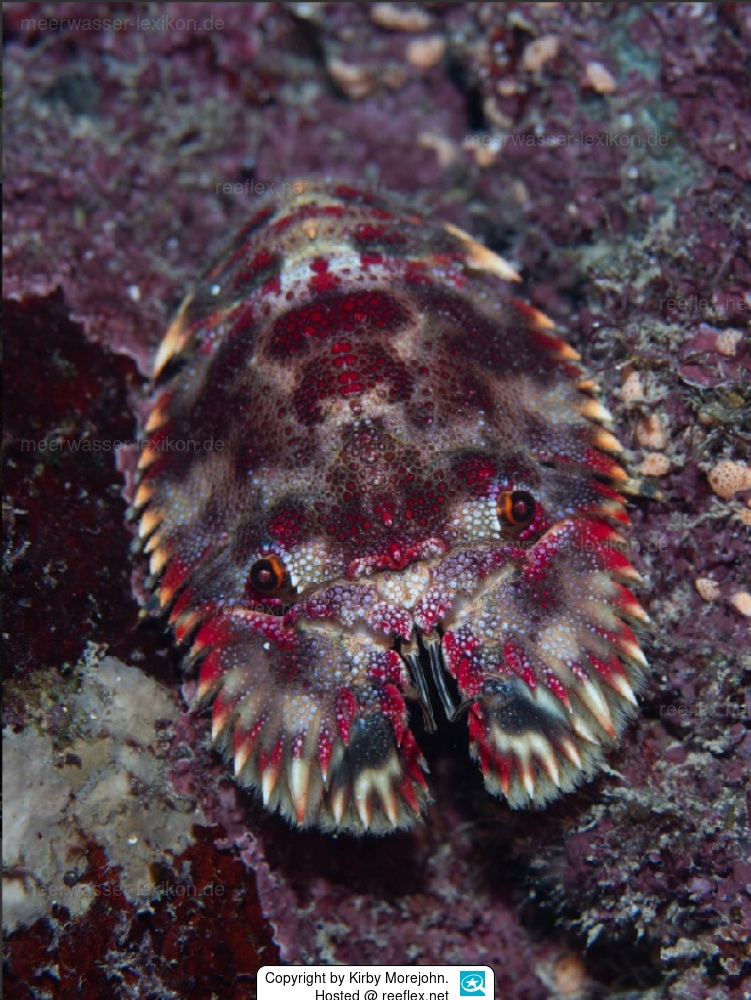
We would like to extend our sincere thanks to marine biologist Kirby Moreiohn of the United States and to Adrien Cantat of France for the first beautiful photos of Parribacus holthuisi; the photos were taken in the Cook Islands in the South Pacific and in Makatea, Rangiroa, French Polynesia.
In fresh specimens, the carapace is pale brownish-yellow with numerous small, dark, irregularly arranged spots; larger dark spots are found at the bases of the lateral teeth.
The spots are dark violet, with only those in the posterior section being more reddish; three fairly large red spots are located on the posterior edge of the carapace, one in the center and two to the sides of it.
The margin of the eye socket is red across most of the outer half and about half of the inner half, with these two red areas separated by a short, uncolored space.
The first abdominal segment has five red spots on its posterior margin—one in the center and two on the sides—which are distributed fairly regularly along the margin.
In front of these spots is a transverse row of about 10 to 12 small red spots.
Red spots are also found on the posterior margin of the second through fifth somites; there are five on the second and four on the other somites, while a red spot may also be present on the posterior basal angle of the abdominal pleura. Small red spots are present on the smooth part of the somites and on the anterior part of the tuberculate half.
All red spots on the carapace and abdomen are well-defined and surrounded by a dark, violet ring.
The inner spines of the antennae are either red or have a red spot at the base.
A dark spot is present on the last antenna segment, near the base and along the base of the outer tines of the second segment.
In some specimens, the legs are darkly banded, similar to Parribacus caledonicus.
The underside of the body is colorless, apart from a few dark spots on the antennae. The color pattern is very persistent, and the red spots on the carapace, eye sockets, and abdomen are still visible even in Stimpsons specimen, which has been preserved in alcohol for more than 100 years.
In some of the other specimens, the coloration is still very fresh, while in others it has faded significantly, and here the red of the eye sockets has practically disappeared entirely, although the rest of the pattern is still clearly visible.
The color pattern appears to be quite consistent and is one of the simplest characteristics for distinguishing between species.
Size:
The carapace length of the males examined varied between 43 and 58 mm, and that of the females between 27 and 65 mm.
One female with a carapace length of 55 mm was equipped with spermatophores.
On Raroia, an island in French Polynesia, Parribacus holthuisi is used as food and is collected by the locals at low tide.
In fresh specimens, the carapace is pale brownish-yellow with numerous small, dark, irregularly arranged spots; larger dark spots are found at the bases of the lateral teeth.
The spots are dark violet, with only those in the posterior section being more reddish; three fairly large red spots are located on the posterior edge of the carapace, one in the center and two to the sides of it.
The margin of the eye socket is red across most of the outer half and about half of the inner half, with these two red areas separated by a short, uncolored space.
The first abdominal segment has five red spots on its posterior margin—one in the center and two on the sides—which are distributed fairly regularly along the margin.
In front of these spots is a transverse row of about 10 to 12 small red spots.
Red spots are also found on the posterior margin of the second through fifth somites; there are five on the second and four on the other somites, while a red spot may also be present on the posterior basal angle of the abdominal pleura. Small red spots are present on the smooth part of the somites and on the anterior part of the tuberculate half.
All red spots on the carapace and abdomen are well-defined and surrounded by a dark, violet ring.
The inner spines of the antennae are either red or have a red spot at the base.
A dark spot is present on the last antenna segment, near the base and along the base of the outer tines of the second segment.
In some specimens, the legs are darkly banded, similar to Parribacus caledonicus.
The underside of the body is colorless, apart from a few dark spots on the antennae. The color pattern is very persistent, and the red spots on the carapace, eye sockets, and abdomen are still visible even in Stimpsons specimen, which has been preserved in alcohol for more than 100 years.
In some of the other specimens, the coloration is still very fresh, while in others it has faded significantly, and here the red of the eye sockets has practically disappeared entirely, although the rest of the pattern is still clearly visible.
The color pattern appears to be quite consistent and is one of the simplest characteristics for distinguishing between species.
Size:
The carapace length of the males examined varied between 43 and 58 mm, and that of the females between 27 and 65 mm.
One female with a carapace length of 55 mm was equipped with spermatophores.
On Raroia, an island in French Polynesia, Parribacus holthuisi is used as food and is collected by the locals at low tide.


