


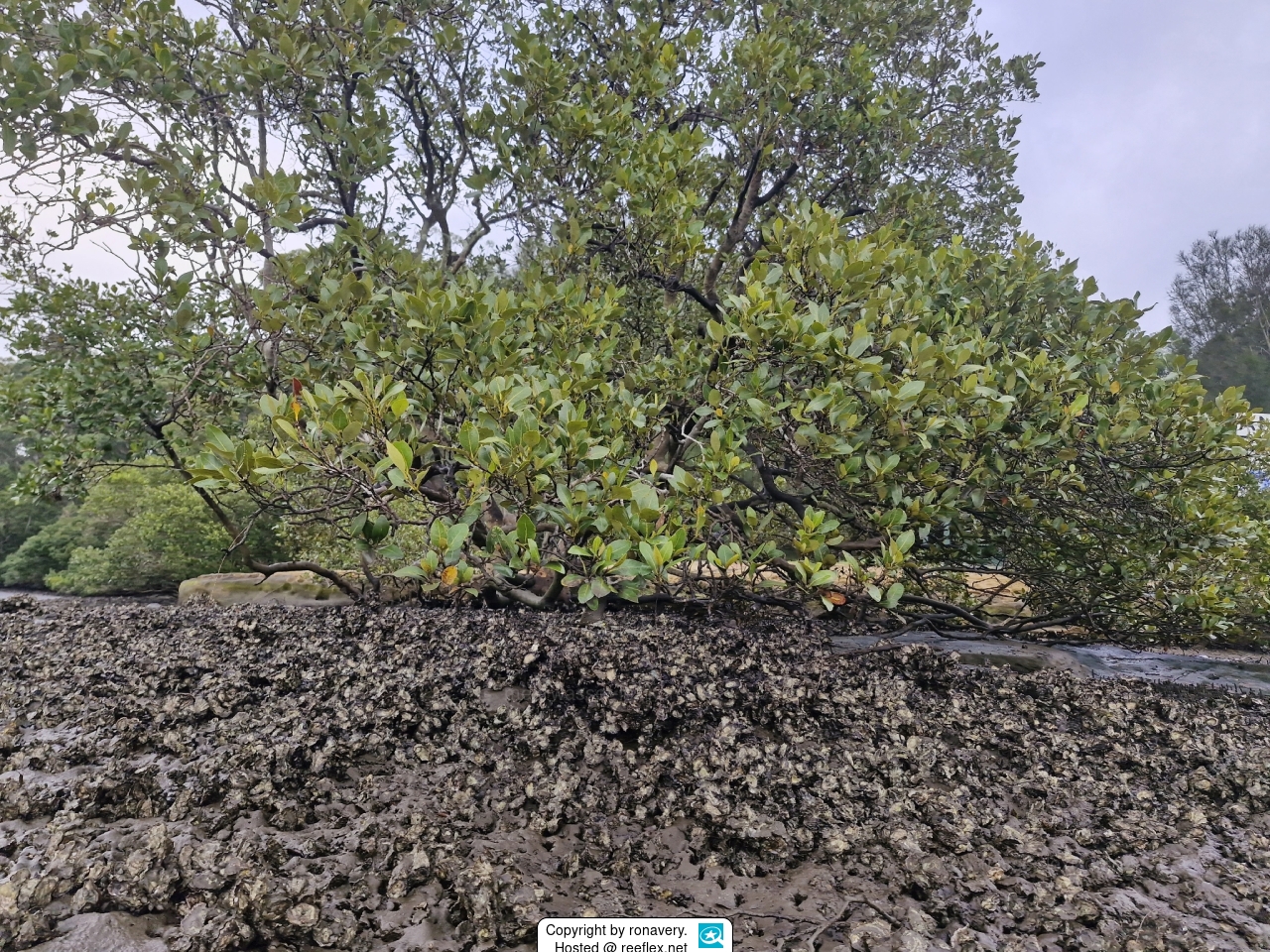
 ronavery, Australien

Info
Avicennia marina forms monospecific stands and provides resting and nesting sites for birds; it is also a very important nursery area for fish and shrimp.
This mangrove species is completely intolerant of shade and can tolerate a maximum pore water salinity of 85 ppt.
Optimal growth occurs at a salinity of 0–30 ppt (Robertson and Alongi 1992).
Avicennia marina is a pioneer species on newly formed habitats of mud with a high sand content, but apparently does not grow on pure mud (Peng and Xin-men 1983).
Under natural conditions, the grey mangrove is a resilient species and regenerates rapidly from coppice shoots, both as individual plants and as a species. It is a colonizing species on newly formed mudflats in Southeast Asia (Terrados et al. 1997) and exhibits high tolerance to hypersaline conditions.
Trunk: large, with finely fissured, gray bark.
Roots: Spongy, pencil-like roots, known as pneumatophores, which grow vertically as specialized root structures and spread out from the trunk, allowing the mangrove roots to breathe in the intertidal zone.
The pneumatophores are covered with lenticels (air pores) that facilitate gas exchange with the atmosphere.
Leaf characteristics: leathery and narrow-obovate to obovate-lanceolate (generally oval and tapering to a point), arranged oppositely on the stems.
The leaves can grow up to 8 cm long and 5 cm wide.
Leaf color: On the upper surface, the mangrove leaves are glossy green; on the underside, they are light gray and slightly hairy, with special glands for excreting excess salt.
Flowers: Yellow or orange, in small, dense clusters.
Fruits and seeds: The fruits are almond-sized, light green and hairy, 2 cm long and 3 cm wide.
They are compressed, egg-shaped capsules surrounded by the fruit wall, and each fruit contains a single seed.
Grey mangroves grow as shrubs or trees and reach a height of 3 to 10 meters, or even up to 14 meters in tropical regions.
The Ocean Education & Conservation website states that the species can even grow up to 25 meters tall.
Its growth is characterized by a gnarled network of numerous branches.
The bark is smooth and light gray and consists of thin, stiff, brittle scales. It can be whitish, a characteristic described in its common name.
The leaves are thick, 5 to 8 cm (2.0 to 3.1 inches) long, bright, glossy green on top, and silvery-white or gray on the underside with very small, matted hairs.
Like other Avicennia species, it has aerial roots
(pneumatophores) that reach a height of about 20 cm (7.9 inches) and a diameter of 1 cm (0.4 inches). These allow the plant to absorb oxygen, which is scarce in its habitat.
These roots also anchor the plant in the soft substrate of tidal systems during frequent flooding by seawater.
The flowers range from white to golden yellow, are less than 1 cm wide, and grow in clusters of three to five.
The fruit contains large cotyledons that surround the new stem of a seedling. This results in a large, fleshy seed that often germinates on the tree and falls to the ground as a seedling.
The grey mangrove may exhibit stunted growth under excessively saline water conditions but reaches its full height in waters where both salt and fresh water are present. The species can tolerate high salinity by excreting salts through its leaves.
The gray mangrove is a highly variable tree with a range of ecotypes and forms that closely resemble other species. It has been reported to tolerate extreme weather conditions, strong winds, and various pests and diseases. It is a pioneer plant in muddy soils with a pH of 6.5 to 8.0, but does not tolerate shade.
These trees fix carbon dioxide, storing it in their leaves, stems, and roots through photosynthesis, thereby producing oxygen and glucose!
Synonyms:
Avicennia intermedia Griff. · unaccepted
Avicennia mindanaense Elmer · unaccepted
This mangrove species is completely intolerant of shade and can tolerate a maximum pore water salinity of 85 ppt.
Optimal growth occurs at a salinity of 0–30 ppt (Robertson and Alongi 1992).
Avicennia marina is a pioneer species on newly formed habitats of mud with a high sand content, but apparently does not grow on pure mud (Peng and Xin-men 1983).
Under natural conditions, the grey mangrove is a resilient species and regenerates rapidly from coppice shoots, both as individual plants and as a species. It is a colonizing species on newly formed mudflats in Southeast Asia (Terrados et al. 1997) and exhibits high tolerance to hypersaline conditions.
Trunk: large, with finely fissured, gray bark.
Roots: Spongy, pencil-like roots, known as pneumatophores, which grow vertically as specialized root structures and spread out from the trunk, allowing the mangrove roots to breathe in the intertidal zone.
The pneumatophores are covered with lenticels (air pores) that facilitate gas exchange with the atmosphere.
Leaf characteristics: leathery and narrow-obovate to obovate-lanceolate (generally oval and tapering to a point), arranged oppositely on the stems.
The leaves can grow up to 8 cm long and 5 cm wide.
Leaf color: On the upper surface, the mangrove leaves are glossy green; on the underside, they are light gray and slightly hairy, with special glands for excreting excess salt.
Flowers: Yellow or orange, in small, dense clusters.
Fruits and seeds: The fruits are almond-sized, light green and hairy, 2 cm long and 3 cm wide.
They are compressed, egg-shaped capsules surrounded by the fruit wall, and each fruit contains a single seed.
Grey mangroves grow as shrubs or trees and reach a height of 3 to 10 meters, or even up to 14 meters in tropical regions.
The Ocean Education & Conservation website states that the species can even grow up to 25 meters tall.
Its growth is characterized by a gnarled network of numerous branches.
The bark is smooth and light gray and consists of thin, stiff, brittle scales. It can be whitish, a characteristic described in its common name.
The leaves are thick, 5 to 8 cm (2.0 to 3.1 inches) long, bright, glossy green on top, and silvery-white or gray on the underside with very small, matted hairs.
Like other Avicennia species, it has aerial roots
(pneumatophores) that reach a height of about 20 cm (7.9 inches) and a diameter of 1 cm (0.4 inches). These allow the plant to absorb oxygen, which is scarce in its habitat.
These roots also anchor the plant in the soft substrate of tidal systems during frequent flooding by seawater.
The flowers range from white to golden yellow, are less than 1 cm wide, and grow in clusters of three to five.
The fruit contains large cotyledons that surround the new stem of a seedling. This results in a large, fleshy seed that often germinates on the tree and falls to the ground as a seedling.
The grey mangrove may exhibit stunted growth under excessively saline water conditions but reaches its full height in waters where both salt and fresh water are present. The species can tolerate high salinity by excreting salts through its leaves.
The gray mangrove is a highly variable tree with a range of ecotypes and forms that closely resemble other species. It has been reported to tolerate extreme weather conditions, strong winds, and various pests and diseases. It is a pioneer plant in muddy soils with a pH of 6.5 to 8.0, but does not tolerate shade.
These trees fix carbon dioxide, storing it in their leaves, stems, and roots through photosynthesis, thereby producing oxygen and glucose!
Synonyms:
Avicennia intermedia Griff. · unaccepted
Avicennia mindanaense Elmer · unaccepted

