


 Thomas Koffel, Frankreich

Info
This species is commonly known as the “Chinese spinning top shell,” which appears to be a historically inherited name and does not reflect its current range; the species is not found in China but is endemic to the coasts of South Africa.
Oxystele sinensis prefers habitats with strong wave action and is often found on rocks in the surf zone; it contributes to biodiversity and the ecological balance of rocky coastal ecosystems.
In the food chain, Oxystele sinensis serves as prey for various predators and actively helps regulate algae populations.
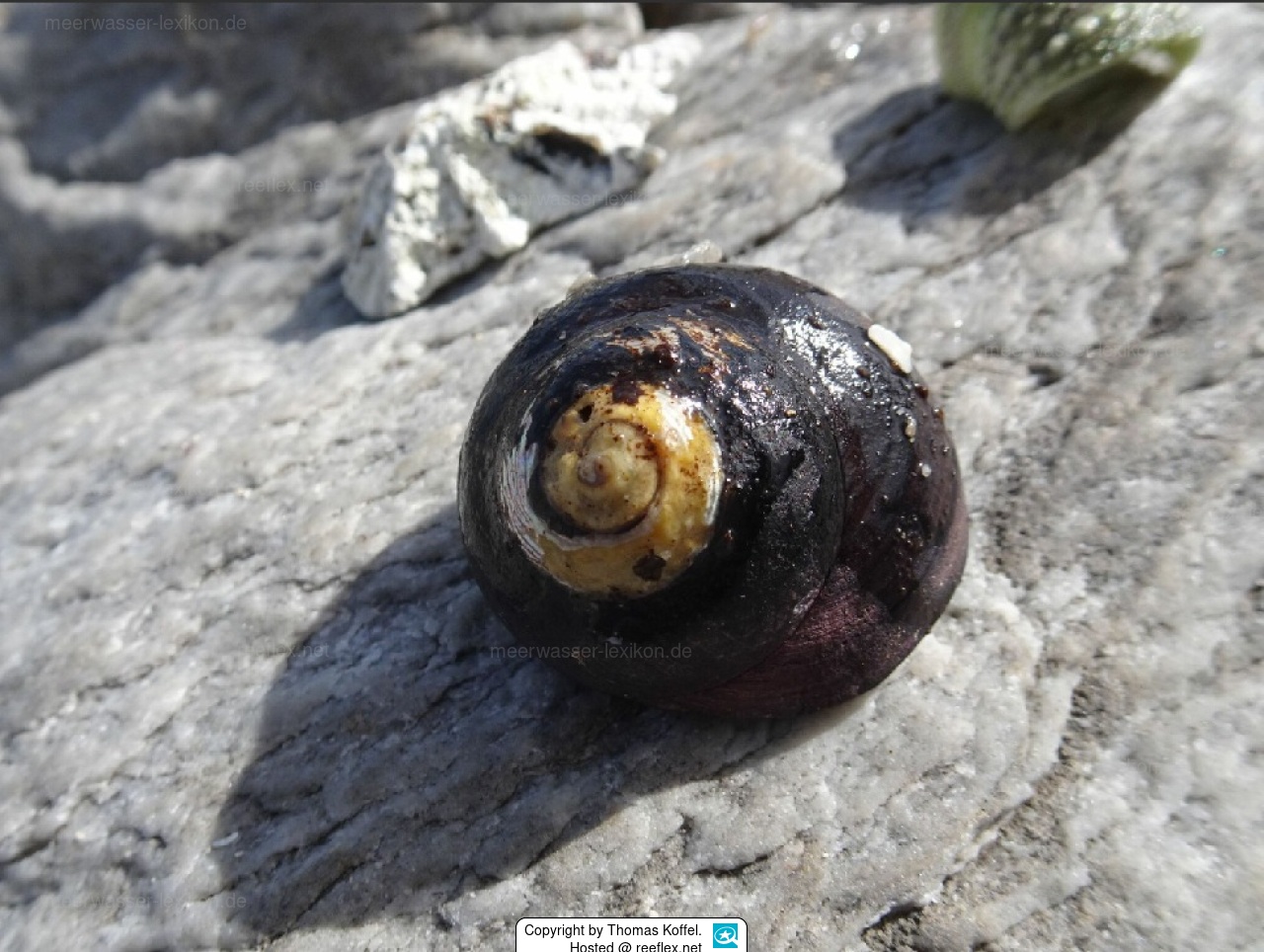
This spiral snail has a solid, unperforated, and somewhat flattened, spherical shell.
The shell color is typically slate-gray or black, but may also appear reddish or brownish, especially when worn.
The turret is short and conical with a pointed tip, often red in color, and the shell surface features fine spiral grooves.
The body whorl is usually indented or slightly concave below the suture, and the base is rounded with an iridescent area near the aperture.
The aperture itself is large, oblique, and iridescent, with a thin outer lip bordered by a pale iridescent band.
The columella is concave and broad, lined with an opaque white layer.
This species is herbivorous and feeds on microalgae and biofilms that grow on or colonize rock surfaces.
Its radula, a specialized feeding organ, scrapes algae from the substrate, thereby playing a role in regulating algae growth in its habitat.
In South Africa, the coral red alga Spongites discoidea is dominant; the snail uses it for camouflage to protect itself from predators in addition to its shell.
According to the standard reference work “Two Oceans” by Branch, Griffiths & Beckley, the tower snail also feeds on Spongites discoidea and other encrusting algae.
Synonyms:
Diloma sinense (Gmelin, 1791) · unaccepted
Oxystele inflata W. H. Turton, 1932 · unaccepted
Oxystele merula (Röding, 1978) · unaccepted
Trochus merula (Röding, 1798) · unaccepted
Trochus meruloides Krauss, 1848 · unaccepted
Trochus sinensis Gmelin, 1791 · unaccepted (original combination)
Turbo merula Röding, 1798 · unaccepted
Oxystele sinensis prefers habitats with strong wave action and is often found on rocks in the surf zone; it contributes to biodiversity and the ecological balance of rocky coastal ecosystems.
In the food chain, Oxystele sinensis serves as prey for various predators and actively helps regulate algae populations.
This spiral snail has a solid, unperforated, and somewhat flattened, spherical shell.
The shell color is typically slate-gray or black, but may also appear reddish or brownish, especially when worn.
The turret is short and conical with a pointed tip, often red in color, and the shell surface features fine spiral grooves.
The body whorl is usually indented or slightly concave below the suture, and the base is rounded with an iridescent area near the aperture.
The aperture itself is large, oblique, and iridescent, with a thin outer lip bordered by a pale iridescent band.
The columella is concave and broad, lined with an opaque white layer.
This species is herbivorous and feeds on microalgae and biofilms that grow on or colonize rock surfaces.
Its radula, a specialized feeding organ, scrapes algae from the substrate, thereby playing a role in regulating algae growth in its habitat.
In South Africa, the coral red alga Spongites discoidea is dominant; the snail uses it for camouflage to protect itself from predators in addition to its shell.
According to the standard reference work “Two Oceans” by Branch, Griffiths & Beckley, the tower snail also feeds on Spongites discoidea and other encrusting algae.
Synonyms:
Diloma sinense (Gmelin, 1791) · unaccepted
Oxystele inflata W. H. Turton, 1932 · unaccepted
Oxystele merula (Röding, 1978) · unaccepted
Trochus merula (Röding, 1798) · unaccepted
Trochus meruloides Krauss, 1848 · unaccepted
Trochus sinensis Gmelin, 1791 · unaccepted (original combination)
Turbo merula Röding, 1798 · unaccepted


