



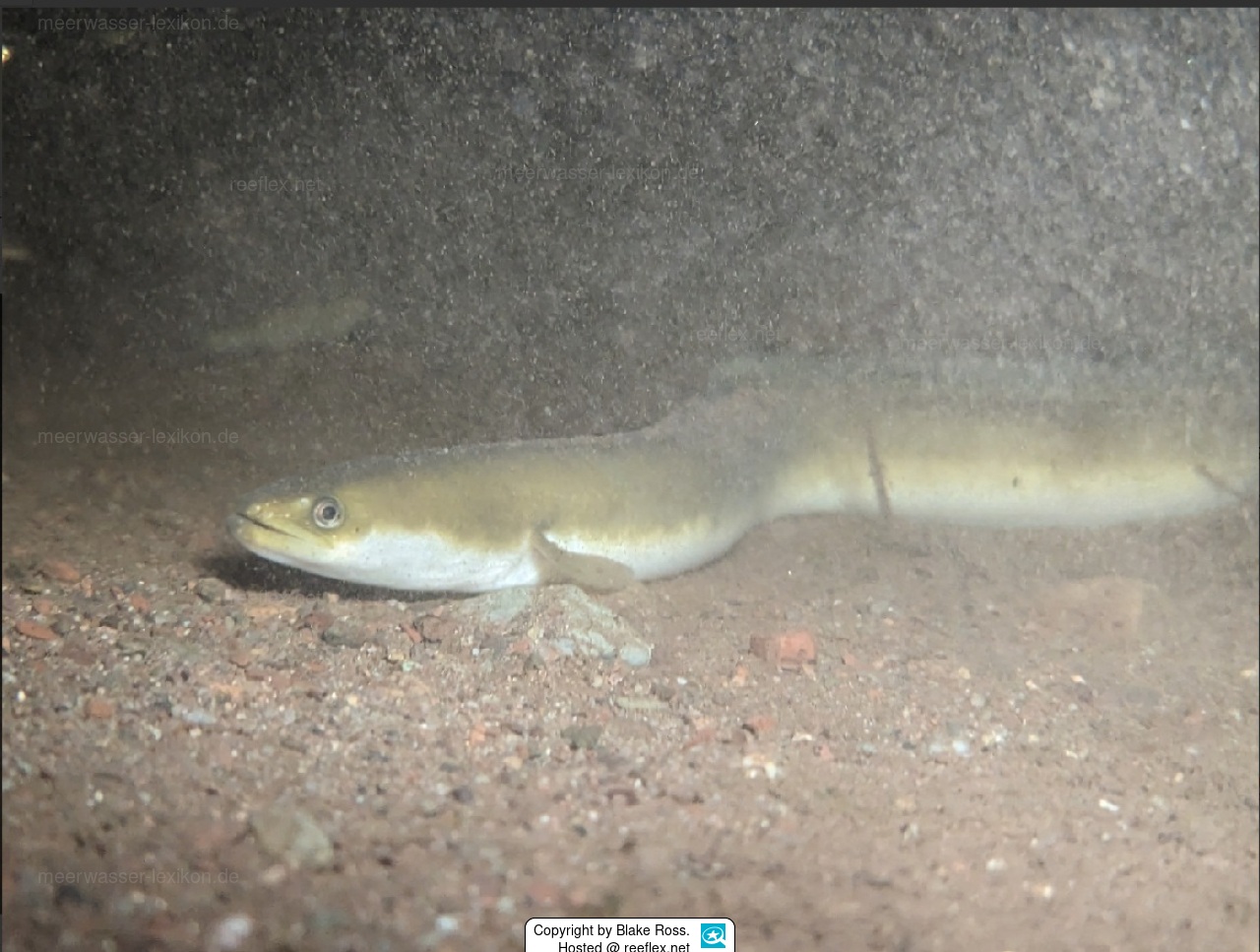
 Blake Ross, Kanada


Info
While the European eel (Anguilla anguilla) is already classified as “Critically Endangered” on the IUCN Red List of Threatened Species, the American eel is still listed as “Endangered”—the only question is how much longer.
What do these two eels have in common? Both species spawn in the Sargasso Sea, and their glass eels are caught in large numbers along the coasts.
In our view, there is nothing wrong with catching them for conservation purposes through aquaculture; however, mass transport to Asia—where the animals are fattened up and then sent back as adults for slaughter—is reprehensible.
You can find some information on “eel tourism” here, among other places:
https://www.dafv.de/themen/politik/europaarbeit/so-viele-glasaale-beschlagnahmt-wie-niemals-zuvor
Unfortunately, this eel species is also considered to be a single-spawning species.
The coloration of American eels changes upon reaching sexual maturity.
The upper surface of the pectoral fins darkens, the lateral line becomes more prominent, the eye diameter increases, the visual pigments change, and the body takes on a silvery-bronze coloration.
Females are generally larger than males and migrate significantly farther upstream.
In addition to the food items listed above, Anguilla rostrata also preys on amphibians such as frogs.
Synonyms:
Anguilla aterrima Rafinesque, 1820 · unaccepted
Anguilla blephura Rafinesque, 1817 · unaccepted
Anguilla bostoniensis (Lesueur, 1817) · unaccepted
Anguilla chrisypa Rafinesque, 1817 · unaccepted
Anguilla cubana Kaup, 1856 · unaccepted
Anguilla laticanda Rafinesque, 1818 · unaccepted
Anguilla laticauda Rafinesque, 1818 · unaccepted (synonym)
Anguilla lutea Rafinesque, 1820 · unaccepted
Anguilla macrops Kaup, 1856 · unaccepted
Anguilla novaeorleanensis Kaup, 1856 · unaccepted
Anguilla novaeterrae Kaup, 1856 · unaccepted
Anguilla punctatissima Kaup, 1856 · unaccepted
Anguilla tenuirostris DeKay, 1842 · unaccepted
Anguilla texana Kaup, 1856 · unaccepted
Anguilla tyrannus Girard, 1858 · unaccepted
Anguilla wabashensis Kaup, 1856 · unaccepted
Anguilla xanthomelas Rafinesque, 1820 · unaccepted (synonym)
Leptocephalus grassii Eigenmann & Kennedy, 1902 · unaccepted
Muraena argentea Lesueur, 1817 · unaccepted
Muraena bostoniensis Lesueur, 1817 · unaccepted (synonym)
Muraena macrocephala Lesueur, 1817 · unaccepted
Muraena rostrata Lesueur, 1817 · unaccepted
Muraena serpentina Lesueur, 1817 · unaccepted
What do these two eels have in common? Both species spawn in the Sargasso Sea, and their glass eels are caught in large numbers along the coasts.
In our view, there is nothing wrong with catching them for conservation purposes through aquaculture; however, mass transport to Asia—where the animals are fattened up and then sent back as adults for slaughter—is reprehensible.
You can find some information on “eel tourism” here, among other places:
https://www.dafv.de/themen/politik/europaarbeit/so-viele-glasaale-beschlagnahmt-wie-niemals-zuvor
Unfortunately, this eel species is also considered to be a single-spawning species.
The coloration of American eels changes upon reaching sexual maturity.
The upper surface of the pectoral fins darkens, the lateral line becomes more prominent, the eye diameter increases, the visual pigments change, and the body takes on a silvery-bronze coloration.
Females are generally larger than males and migrate significantly farther upstream.
In addition to the food items listed above, Anguilla rostrata also preys on amphibians such as frogs.
Synonyms:
Anguilla aterrima Rafinesque, 1820 · unaccepted
Anguilla blephura Rafinesque, 1817 · unaccepted
Anguilla bostoniensis (Lesueur, 1817) · unaccepted
Anguilla chrisypa Rafinesque, 1817 · unaccepted
Anguilla cubana Kaup, 1856 · unaccepted
Anguilla laticanda Rafinesque, 1818 · unaccepted
Anguilla laticauda Rafinesque, 1818 · unaccepted (synonym)
Anguilla lutea Rafinesque, 1820 · unaccepted
Anguilla macrops Kaup, 1856 · unaccepted
Anguilla novaeorleanensis Kaup, 1856 · unaccepted
Anguilla novaeterrae Kaup, 1856 · unaccepted
Anguilla punctatissima Kaup, 1856 · unaccepted
Anguilla tenuirostris DeKay, 1842 · unaccepted
Anguilla texana Kaup, 1856 · unaccepted
Anguilla tyrannus Girard, 1858 · unaccepted
Anguilla wabashensis Kaup, 1856 · unaccepted
Anguilla xanthomelas Rafinesque, 1820 · unaccepted (synonym)
Leptocephalus grassii Eigenmann & Kennedy, 1902 · unaccepted
Muraena argentea Lesueur, 1817 · unaccepted
Muraena bostoniensis Lesueur, 1817 · unaccepted (synonym)
Muraena macrocephala Lesueur, 1817 · unaccepted
Muraena rostrata Lesueur, 1817 · unaccepted
Muraena serpentina Lesueur, 1817 · unaccepted

